
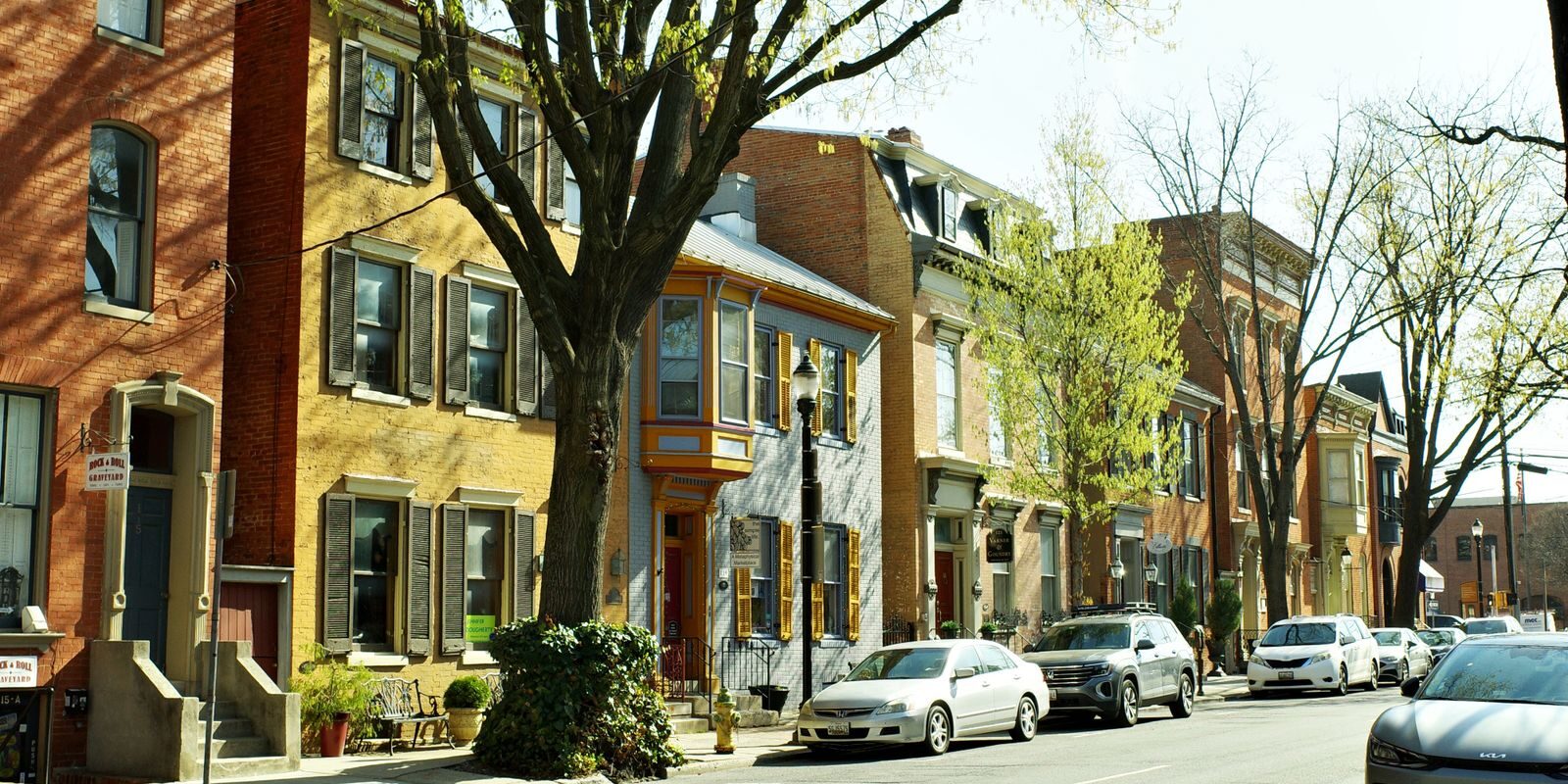
Maryland HELOC 2026: DC Suburbs, Baltimore Metro, and the Ground Rent Wrinkle No Other State Has
Maryland HELOC underwriting has two things going for homeowners: a straightforward 90% CLTV cap without state constitutional restrictions like Texas, and a demographic profile (DC suburbs + Baltimore metro) where equity positions have grown substantially since 2020. It also has one legal wrinkle that exists in almost no other state: ground rent. Roughly 85,000 Maryland properties are still subject to active ground rent leases (mostly in Baltimore, Baltimore County, and Prince George’s County), and this affects HELOC underwriting in specific ways every Maryland homeowner should understand.
This post covers the Maryland-specific HELOC playbook: what the DC-suburb high-value market looks like, how the Baltimore metro middle market processes, when ground rent complicates the file, and worked scenarios for Bethesda and Baltimore County. If you’re in Bethesda, Rockville, Silver Spring, Chevy Chase, Frederick, Gaithersburg, Baltimore, Columbia, Annapolis, Towson, or Ocean City, this is the framework OnPoint Mortgage Pro uses on your file. See our full HELOC product page for general parameters that apply across all 9 licensed states.
Quick answer: Maryland HELOCs allow up to 90% CLTV on primary residences with no state constitutional restrictions. Two-market reality (DC suburbs Montgomery/PG County + Baltimore metro + Eastern Shore) means dollar amounts vary dramatically by region. Three things make Maryland distinct from neighboring states: (1) high combined state + local income tax (6-9% total) makes itemization the norm for most homeowners, boosting the mortgage interest deduction value, (2) ground rent on roughly 85,000 Baltimore-area properties requires specific title work in underwriting, (3) Maryland’s judicial-with-power-of-sale foreclosure process is slightly slower than pure non-judicial states which adds a small pricing premium. HELOC rates in July 2026: 8.25-9.5% variable. Full walkthrough with worked $850K Bethesda and $380K Baltimore County scenarios below.
On This Page
- Maryland’s Three-Market Reality
- Factor #1: Standard 90% CLTV (No State Constitutional Restrictions)
- Factor #2: Moderate Property Tax + High Income Tax = Strong Itemization
- Factor #3: Judicial-With-Power-of-Sale Foreclosure
- Factor #4: The Ground Rent Wrinkle (Maryland-Unique)
- Factor #5: Second Homes and Eastern Shore Properties
- Factor #6: Baltimore Rowhouse Appraisal Complexity
- Factor #7: Chesapeake Bay Critical Areas
- Worked Scenario A: $850K Bethesda DC Suburb Home
- Worked Scenario B: $380K Baltimore County Rowhouse with Ground Rent
- Smart Maryland HELOC Uses in 2026
- The OnPoint Maryland HELOC Process
- FAQs
Maryland’s Three-Market Reality
Understanding Maryland HELOC dynamics starts with knowing which of three markets you’re in. Home values, homeowner demographics, and equity positions vary substantially across the state:
DC Suburbs (Montgomery County + Prince George’s County): Bethesda, Chevy Chase, Potomac, Rockville, Silver Spring, Kensington, Wheaton, Frederick County commuter suburbs, and northern PG County. Home values typically $600K-$1.8M+ (Bethesda / Chevy Chase / Potomac push $1.5M+). Homeowner demographics: federal government workers, defense and intelligence contractors, biotech / healthcare professionals (NIH corridor), lobbyists, and DC-area consultants. Combined household income $250K-$600K normal. Strong 5-year appreciation. Equity positions frequently $400K-$800K+ on primary residences.
Baltimore Metro: Baltimore City, Baltimore County, Howard County (Columbia), Anne Arundel County (Annapolis + Glen Burnie), Harford County, Carroll County. Home values $275K-$650K typical for single-family, $200K-$400K for classic Baltimore rowhouses. More typical middle-market demographic. Healthcare (Johns Hopkins), academia, and Port of Baltimore adjacent industries drive employment.
Eastern Shore + Outlying Areas: Ocean City, Salisbury, Cambridge, St. Michaels, Chestertown, Western Maryland (Cumberland, Frostburg). Vacation home market for Baltimore/DC residents. Also year-round primary residences with lower home values ($225K-$500K typical) and different HELOC dynamics.
The rules that follow apply across all three markets. Dollar amounts and specific complications shift by region.
Factor #1: Standard 90% CLTV (No State Constitutional Restrictions)
The rule: Maryland HELOCs allow up to 90% combined loan-to-value on primary residences. No state constitutional restrictions like Texas’s Article XVI. Standard federal home equity lending rules apply.
Formula: (Home fair market value × 90%) − existing first mortgage balance = maximum HELOC available.
Example (Bethesda): $1.4M home, $650K first mortgage = ($1.4M × 90%) − $650K = $610K max HELOC. Line ceilings at DC-suburb equity levels can push $500K-$750K on high-value primary residences.
Example (Baltimore County): $420K home, $200K first mortgage = ($420K × 90%) − $200K = $178K max HELOC. More typical middle-market territory.
Factor #2: Moderate Property Tax + High Income Tax = Strong Itemization
Property tax: Maryland’s effective property tax rate is approximately 1.05% of home value. Moderate — comparable to California (1.10%) but well below Texas (1.74%). Rate varies by county: Montgomery County ~1.00%, Anne Arundel ~0.95%, Baltimore City ~1.75% (highest in state), Baltimore County ~1.15%, Frederick County ~1.10%.
State income tax: Maryland charges a 4.75-5.75% state income tax on higher earners, PLUS a local (county) income tax of 2.25-3.20%. Total combined state + local income tax burden runs 7-9% for Maryland households in the middle-to-upper tax brackets. Among the highest state-plus-local income tax rates in the country.
What this means for HELOC math: Almost every Maryland homeowner easily clears the federal standard deduction threshold ($27,700 married filing jointly in 2026) when combining mortgage interest + property tax (capped at $10K SALT) + state/local income tax + charitable giving. Itemization is the default, not the exception, in Maryland.
Practical implication: Mortgage interest deduction on qualifying HELOC uses (home improvement, purchase, substantial improvement) has real dollar value for most Maryland homeowners. This differs from Florida (no state income tax, many homeowners can’t clear the standard deduction) where the MID often provides no benefit. Confirm with your CPA on your specific tax picture.
Factor #3: Judicial-With-Power-of-Sale Foreclosure
The reality: Maryland uses a hybrid foreclosure process. Most HELOC (and mortgage) deeds of trust include a “power of sale” clause that allows a semi-non-judicial foreclosure process through court-appointed trustees. The process is faster than pure judicial foreclosure but slower than pure non-judicial (trustee sale) states like Colorado and California.
Timeline: Maryland foreclosures typically take 6-12 months from initial default through completed sale (vs 3-4 months in pure non-judicial states, or 12-24+ months in pure judicial states like Florida).
What it means for HELOC pricing: Slight premium on rates versus pure non-judicial states. Expect Maryland HELOC rates approximately 0.125% above Colorado or Virginia rates on comparable files, and 0.125% below pure judicial states like Florida.
Factor #4: The Ground Rent Wrinkle (Maryland-Unique)
What is ground rent? Ground rent is a Maryland real estate arrangement (dating back to colonial land grants) where the homeowner owns the house/building but does NOT own the land underneath. The homeowner pays annual “ground rent” (typically $60-$240/year) to the ground rent owner, who has ownership of the underlying land subject to a very long lease (typically 99 years, renewable).
Where it exists: Approximately 85,000 Maryland residential properties are still subject to active ground rents in 2026, concentrated in Baltimore City (majority of ground rent inventory), Baltimore County, Prince George’s County, and pockets of Anne Arundel County. New residential construction has largely stopped using ground rent structures, but existing ground rent properties remain subject to the terms.
Why it matters for HELOC underwriting:
- Title work is more complex. Ground rent properties require additional title searches to confirm the ground rent is properly documented, current on payments, and the ground rent owner’s identity is known.
- Some lenders won’t fund ground rent properties. Not every HELOC investor accepts ground rent files. Shopping across specialty investors matters.
- Ground rent redemption option. Maryland law allows homeowners to buy out ground rents for a fixed formula (typically 10-16x annual ground rent). Some HELOC proceeds can be used to redeem the ground rent, converting the property to fee simple ownership. This often improves future refinance and sale options.
- Ground rent registration required. Maryland requires all ground rents to be registered with the State Department of Assessments and Taxation (SDAT). Unregistered ground rents were extinguished by law in 2010, but the record needs to be confirmed for the specific property.
Practical implication: If your Baltimore-area property is subject to ground rent, disclose that during the discovery call. We can identify HELOC investors who work with ground rent files and potentially structure the transaction to redeem the ground rent as part of the HELOC use. If your property is NOT subject to ground rent (most non-Baltimore Maryland properties aren’t), this factor is moot.
Factor #5: Second Homes and Eastern Shore Properties
The rule: Maryland permits HELOCs on second homes and investment properties (unlike Texas). This matters for Ocean City vacation homes, Eastern Shore properties, Chesapeake Bay waterfront residences, and Deep Creek Lake mountain properties.
Second home HELOC terms in Maryland:
- Maximum CLTV: 65-75% (lower than primary residence)
- Rate: 0.5-1.0% above primary residence HELOC rates
- Reserves required: 6-12 months of PITI including new HELOC payment
- Vacation rental income (Ocean City, Deep Creek) can qualify at 75% of documented net
Typical use case: DC or Baltimore area primary homeowner extracting equity on Ocean City oceanfront rental or Eastern Shore vacation home to fund upgrades or a second investment property.
Factor #6: Baltimore Rowhouse Appraisal Complexity
The reality: Baltimore has one of the largest concentrations of historic rowhouses in the country (Federal Hill, Fell’s Point, Canton, Mount Vernon, Bolton Hill, Reservoir Hill, Charles Village, Hampden, Roland Park). Rowhouse valuations can vary significantly based on block, block face, historic designation, renovation status, and specific architectural features.
How it affects HELOC underwriting: Appraisals on Baltimore rowhouses can require specialist appraisers familiar with the specific neighborhood. Comparable sales analysis needs care because block-to-block value variation can be 30-50% for structurally similar properties. Recent renovations vs original condition can create wide value differences.
Practical implication: Baltimore rowhouse HELOCs may take 3-7 extra days for appraisal versus suburban single-family. If your rowhouse is in a historic district (Federal Hill, Mount Vernon, Bolton Hill, others), historic review adds additional time. Total timeline typically 25-30 days versus 17-22 for standard suburban files.
Factor #7: Chesapeake Bay Critical Areas
The reality: Maryland has extensive Chesapeake Bay Critical Area regulations that limit development and impose special requirements on properties within 1,000 feet of tidal waters. Applies to most Anne Arundel County waterfront, Eastern Shore properties, and lower Baltimore County properties on the bay.
How it affects HELOC underwriting: Similar to Virginia’s Chesapeake Bay Preservation Areas. Standard HELOC applications on Critical Area properties usually process without incident. If your HELOC use involves construction, dock installation, or significant landscape work in the buffer zone, disclose upfront so we can identify appropriate lenders and permit requirements.
Worked Scenario A: $850K Bethesda DC Suburb Home
Meet the Kimura family. Bethesda, Montgomery County. Both partners work in federal-adjacent professional services (one at a major consulting firm, one at a biotech). Combined household income: $310,000. Home value: $850,000 (bought in 2018 for $575K, up 48% in 8 years). Existing first mortgage: $410,000 at 3.5% (2021 refinance). They want $175,000 to fund a kitchen + primary bath renovation + their older child’s college tuition starting fall 2026.
Maryland HELOC underwriting on this file:
- Home value: $850,000
- 90% CLTV cap: $765,000 maximum total mortgage debt
- Minus existing first mortgage: $410,000
- Maximum HELOC available: $355,000
- Their target: $175,000 — well within cap, $180K reserve capacity
Financial math:
- $175K HELOC at 8.5% variable, interest-only during draw period
- Monthly HELOC payment during draw period: $1,240
- Preserves the $410K first mortgage at 3.5% — worth roughly $180K in savings over 10 years vs cash-out
- Interest on HELOC use for kitchen/bath renovation (home improvement) is tax-deductible under TCJA rules; interest on the college tuition portion is not. Consult a CPA on allocation.
- At 24% federal + 8% MD combined marginal rate, MID-eligible portion saves approximately 30 cents per dollar of qualifying interest — meaningful in Maryland’s high-tax environment
Timeline: 17-22 days from application to funds available. Standard Montgomery County suburban file, no ground rent complication.
Worked Scenario B: $380K Baltimore County Rowhouse with Ground Rent
Meet the Washington family. Baltimore County (near the city line). They own a rehabbed 1920s brick rowhouse worth $380,000. Bought in 2019 for $265K, put $40K into rehab, so $305K adjusted cost basis. Existing first mortgage: $210,000 at 3.75% (2020 refinance). Property is subject to an active ground rent: $96/year to a ground rent holder registered with SDAT. They want $85,000 to redeem the ground rent + finish basement + establish emergency fund.
Maryland HELOC underwriting on this file:
- Home value: $380,000
- 90% CLTV cap: $342,000 maximum total mortgage debt
- Minus existing first mortgage: $210,000
- Maximum HELOC available: $132,000
- Their target: $85,000 — within cap
Ground rent redemption math:
- Annual ground rent: $96/year
- Redemption formula (Maryland law): typically 12-16x annual ground rent = $1,152-$1,536 to buy out the ground rent
- Additional title work fees to complete redemption: $400-$800
- Total ground rent redemption cost: roughly $2,000
- Ground rent redemption included in HELOC use funds — property converts to fee simple ownership at close
Remaining HELOC use: $83,000 for basement finish and emergency fund establishment.
Financial math:
- $85K HELOC at 8.75% variable (slightly higher due to ground rent underwriting complexity), interest-only during draw period
- Monthly HELOC payment during draw period: $620
- Preserves the $210K first mortgage at 3.75%
- Property converts to fee simple after ground rent redemption, simplifying future refinance or sale
Timeline: 22-28 days from application to funds available. Ground rent file adds 3-6 days for specialized title work and ground rent verification. Investor pool is smaller because not all HELOC lenders accept ground rent properties.
Smart Maryland HELOC Uses in 2026
All the smart uses from our 5 Smart HELOC Uses guide work in Maryland. Uses particularly common on Maryland files:
DC-suburb premium renovation. Montgomery County homeowners maintaining property value with kitchen, primary bath, and basement finishes in a market where neighbor comps set expectations.
Baltimore rowhouse renovation. Historic rehab, primary suite additions, roof-deck builds, HVAC modernization. Rowhouse renovations often add 50-100% of cost to home value in gentrifying neighborhoods.
Ground rent redemption. Maryland-specific opportunity. Convert leasehold property to fee simple, simplifying future transactions. Small dollar amount, but strategically valuable.
College tuition for federal / consulting families. Maryland’s high concentration of federal government + defense contractor + biotech / consulting professionals frequently uses HELOC as a tuition funding vehicle for private colleges. HELOC at 8-9% beats parent PLUS loans at 8-10%.
Second home upgrades on Ocean City / Eastern Shore. Extract equity from primary Maryland home to fund vacation home renovations, or draw HELOC on the vacation home itself.
Business capital for DC-metro consulting or biotech ventures. Similar to Northern Virginia dynamic. Federal contracting and biotech spin-offs use HELOC for launch capital at rates far below business credit alternatives.
Debt consolidation with high-marginal-rate benefit. Maryland’s high state + local income tax means the after-tax benefit of converting high-interest credit card debt to HELOC (with potential MID benefit if funds used for home purposes) can be even better than in low-tax states.
The OnPoint Maryland HELOC Process
OnPoint Mortgage Pro has closed HELOCs for Maryland homeowners in Bethesda, Rockville, Silver Spring, Chevy Chase, Potomac, Kensington, Wheaton, Gaithersburg, Frederick, Baltimore City, Baltimore County (Towson, Catonsville, Dundalk), Howard County (Columbia, Ellicott City), Anne Arundel County (Annapolis, Glen Burnie), Prince George’s County (Bowie, Laurel), Carroll County, Harford County, and Eastern Shore markets. We work with ground rent files, historic rowhouses, and Critical Area waterfront properties.
Day 1-2: Discovery call. We understand your equity, your goal, and your specific market (DC suburb, Baltimore metro, or Eastern Shore). Confirm ground rent status if applicable. Confirm historic district or Critical Area status if applicable. No credit pull at this stage.
Day 3-5: Application signed. We shop across 15+ specialty HELOC investors with active Maryland programs, filtering for those that accept ground rent files if relevant.
Day 6-14: Underwriting + appraisal. Standard suburban files close efficiently. Baltimore rowhouses may require specialist appraisers. Ground rent files require additional title work.
Day 15-22 (standard) or 22-28 (ground rent): Closing scheduled. Federal 3-day rescission. Funds available on day 4 after closing.
Total timeline: 17-22 days for standard suburban files, 22-28 days for ground rent or Baltimore rowhouse files.
Frequently Asked Questions
What’s the maximum HELOC in Maryland?
Formula: (Home fair market value × 90%) − existing first mortgage balance = maximum HELOC. In Bethesda / Chevy Chase / Potomac, this frequently reaches $500K-$750K on high-value primary residences. In Baltimore metro, more typically $100K-$250K range. Second homes cap at 65-75% CLTV.
Does having ground rent on my property mean I can’t get a HELOC?
No. Ground rent doesn’t prevent a HELOC — it just requires specialized underwriting. Not every investor accepts ground rent files, but many do. Shopping across specialty investors is exactly where a wholesale broker adds value on ground rent files. Some homeowners use HELOC proceeds specifically to redeem the ground rent, converting the property to fee simple ownership.
How do I know if my property has ground rent?
Check your property tax bill or deed — ground rent is typically referenced explicitly. You can also search the Maryland State Department of Assessments and Taxation (SDAT) ground rent registry online. If your property was purchased before 2010 and located in Baltimore City, Baltimore County, or Prince George’s County, there’s a reasonable chance ground rent applies.
How long does a Maryland HELOC take to close?
17-22 days for standard suburban files. 22-28 days for Baltimore rowhouses or ground rent files. 25-30 days for historic district or Chesapeake Critical Area waterfront properties.
How do Maryland HELOC rates compare to neighboring states?
Roughly 0.125% higher than Virginia and Colorado (pure non-judicial states) due to Maryland’s slightly slower foreclosure process. Roughly 0.125% lower than Florida (pure judicial state). Comparable to California pricing on similar files.
Does my marginal tax rate matter more in Maryland?
Yes. Maryland’s high combined state + local income tax (7-9% typical) makes itemization automatic for most homeowners, which means mortgage interest deduction on qualifying HELOC uses has real dollar value. In Florida (no state income tax), many homeowners can’t clear the standard deduction so MID benefit is zero. In Maryland, the deduction typically translates to 30-32 cents saved per dollar of qualifying interest at combined marginal rates.
Can I get a HELOC on my Ocean City vacation home?
Yes. Maryland permits second home HELOCs at 65-75% CLTV with slightly higher rates and 6-12 months of PITI reserves required. If the property is a documented short-term rental, some HELOC investors accept 75% of documented net rental income for DTI qualification.
Does OnPoint serve my Maryland city?
Yes. OnPoint is licensed statewide in Maryland. See our Maryland mortgage page for city-specific pages including Baltimore, Frederick, and Gaithersburg.
Can I use HELOC proceeds to redeem the ground rent on my property?
Yes. Ground rent redemption is a permitted use of HELOC funds. Redemption cost is typically $1,000-$3,000 including title work (based on the standard 12-16x annual ground rent formula). Converting your property to fee simple ownership can improve future refinance and sale outcomes.
Does Maryland have a mandatory waiting period like Texas?
No. Maryland follows federal norms — standard 3-day right of rescission after signing for owner-occupied primary residence HELOCs. No additional pre-closing waiting period like Texas’s 12-day rule.
Ready to Set Up a Maryland HELOC?
Maryland HELOCs offer strong flexibility with straightforward federal rules plus a few state-specific wrinkles that a wholesale broker knows how to navigate. Whether you’re a Bethesda homeowner with $500K+ of accessible equity, a Baltimore County rowhouse owner working through ground rent complications, or an Eastern Shore vacation home owner extracting equity for upgrades — the right structure comes from matching your specific file to the right investor.
Call OnPoint Mortgage Pro at (877) 870-0007. Bring your Maryland home value estimate, current first mortgage rate + balance, target line size, target use, county, and ground rent status if applicable — we’ll shop the file across 15+ specialty HELOC investors with active Maryland programs. 30-minute consultation, no email required, no credit pull at first call.
Maryland HELOC rates + high state marginal tax rates = strong economics on qualifying home improvement uses. Ground rent files require specialized underwriting. Get the honest analysis before you commit. Call (877) 870-0007.
See Also: Related Broker Resources
- HELOC Product Page — general parameters that apply across all 9 states.
- 5 Smart Ways to Use a HELOC in 2026 — the use-case framework.
- Texas HELOC 2026 Guide — state-by-state comparison.
- Florida HELOC 2026 Guide — insurance-first playbook.
- Colorado HELOC 2026 Guide — Front Range friendliest market.
- Virginia HELOC 2026 Guide — NoVA + coastal military playbook.
- Cash-Out Refi vs HELOC: Which One Wins — product decision framework.
- Cash-Out Refinance — alternative when HELOC ceilings don’t fit.
- Maryland Mortgage Page — state-specific mortgage services across all product types.
- Baltimore Mortgage | Frederick | Gaithersburg — city-specific pages.
Victor Santos, NMLS #888844, is a Senior Loan Officer and licensed mortgage broker. OnPoint Mortgage Pro (NMLS #2134550) is licensed in California, Colorado, Florida, Idaho, Maryland, New Hampshire, South Carolina, Texas, and Virginia. Maryland HELOC underwriting is subject to federal home equity lending regulations plus state property law including ground rent registration requirements under SDAT rules. Rate ranges, LTV ceilings, and closing cost estimates in this article use representative July 2026 wholesale pricing for illustration. HELOCs are variable-rate products tied to prime; your actual rate will fluctuate over the life of the loan. Ground rent redemption is subject to Maryland law and specific ground rent documentation. Tax deductibility of interest depends on use of proceeds and current tax law; consult a CPA. This article is educational and is not a loan commitment, tax advice, or legal advice. Equal Housing Lender.